Reorientation
Turning to the sky, the seasons, and ourselves in a disconnected world
What our ancestors understood, and what many of us are beginning to rediscover, is that we are not separate from the rhythms of the world around us. And for most of our history, we lived in close relationship with the sky, the seasons, the land, and our own bodies.
We tracked the movement of the stars, marked solstices and equinoxes, gathered for rituals and ceremonies, and looked to stories, symbols, and contemplative practices to help us navigate life’s transitions and mysteries.
Ceremony and meaning-making were once deeply intertwined with our survival as a species, and these observances were shaped by careful attention to the rhythms of the natural and celestial world.
In this current time and space, we are considerably more comfortable then our ancestors, yet we are considerably more miserable than ever. Many of us are noticing a longing building inside of us, even if we can’t put it into words.
Beneath the overstimulation, chronic urgency, endless consumption, and disconnection, we feel a quiet nudge to slow down, reconnect, and feel more grounded in ourselves and the natural world around us.
What an ideal time to turn to our ancestors.

stay connected
join my mailing list for the occasional inbox gem, including a monthly newsletter sent the day before each New Moon.
The Age of Disconnection
Before we turn to the past, let's take an honest look at where we are.
Never before have humans been asked to process so much information, stimulation, and uncertainty all at once; our nervous systems aren't designed to hold all of it.

We wake up and immediately look at a screen instead of out the window. These devices have hijacked our brain stems, while the oligarchs get richer off mining our data.
Artificial light blurs the boundaries between day and night. Endless stimulation and consumption keep us distracted, but rarely nourished, contributing to chronic nervous system overwhelm.
Toxic productivity makes rest feel like a sin, and silence has become so unfamiliar that stillness brings discomfort rather than peace. We have lost our ability to embrace boredom, and we are often not in good company when we are alone.
Intertwined with this, we have become increasingly disconnected from the quieter rhythms of our bodies, often overriding hunger, exhaustion, grief, and the need for rest in order to keep up with the demands of modern life.
In an increasingly synthetic world, it has become too easy to move through life without noticing the seasons and the ways the landscape and energy around us change. Even though many modern holidays are layered over ancient seasonal observances, they no longer orient us to the natural rhythms they were once rooted in. Many of us no longer feel held by the religious institutions that once helped people navigate grief, uncertainty, and life’s inevitable upheavals.
As we become more untethered, our suffering increases, and we have found ourselves living in chronic states of unrest and fear that we don’t know how to move through.
Yet we are still rhythmic beings. We are microcosms of the cosmos, and deeply interconnected with nature and each other in ways we are beginning to truly understand.
Our bodies and our psyches naturally, constantly, seek balance within ourselves and around us, whether we consciously realize it or not. We can support this process by developing anchors, by practicing with intention, and by taking back our attention.
And the good news is, we don’t have to reinvent the wheel.
As Above, So Below
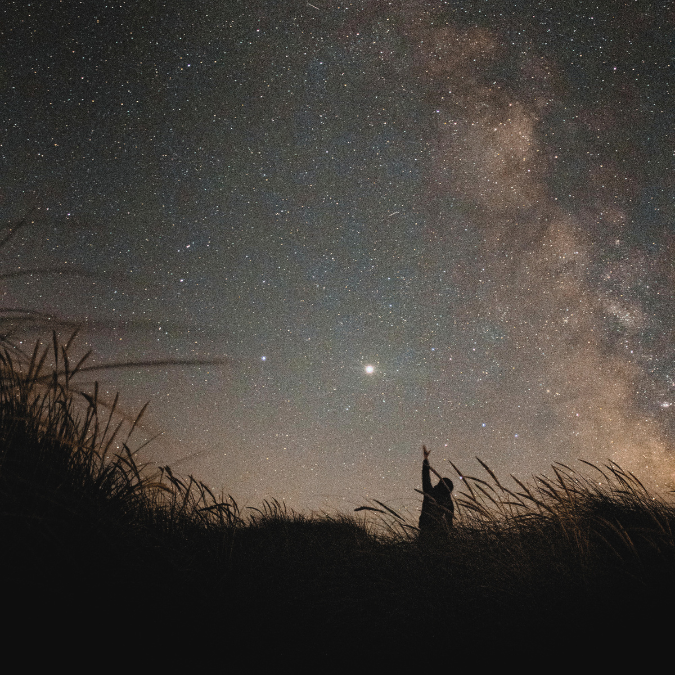
Before clocks and algorithms, we looked to the sky.
The movements of the Sun, Moon, and visible planets helped us track time, anticipate seasonal change, navigate agriculture and migration, and organize ceremony and community life. The sky functioned as both calendar and compass; we looked upward to help make sense of where we were in time, and in nature.
Celestial observation was woven into survival itself.
There was also a symbolic and psychological dimension to this relationship. The phrase “as above, so below” reflects an ancient understanding that we are not separate from the living world, but participants within it. The cycles we observe around us often find echoes within us. Just as the natural world moves through seasons of growth, death, rest, and renewal, so do we.
As humans observed these recurring patterns in both the heavens and the natural world, they began creating rituals and observances to mark them. Solstices, equinoxes, lunar cycles, and seasonal transitions were honored through ceremony, celebration, and communal gathering. These practices helped people orient themselves to the changes in the year, as well as punctuated time in a way that facilitated rites of passages and collective healing.
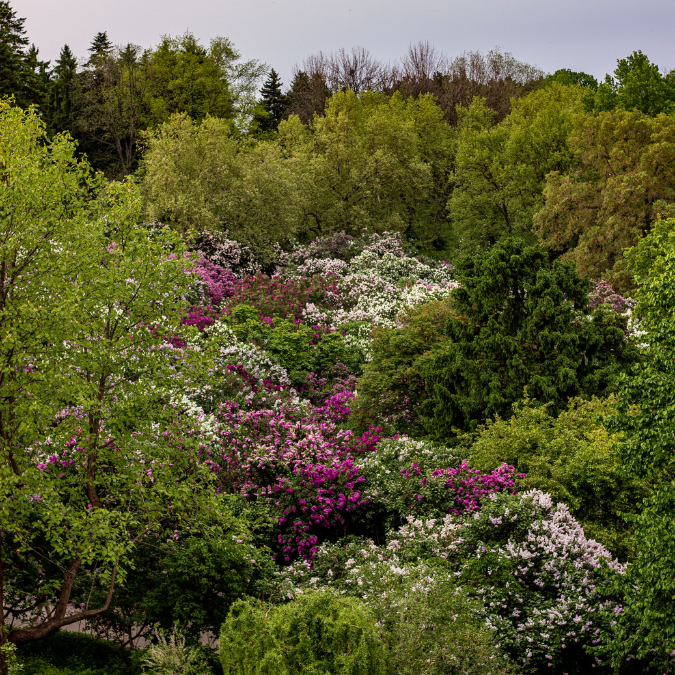
Long before modern industrialized schedules flattened time into productivity and repetition, we experienced the year as alive and changing. Different seasons carried different energies, responsibilities, moods, limitations, and invitations. There were designated times for planting, harvesting, gathering, celebrating, grieving, resting, and preparing for what was to come.
These observances created natural pauses within the flow of life. They invited us to collectively reflect on where we had been, where we were, and what season we were entering, both literally and psychologically. Rituals surrounding seasonal transitions gave us opportunities to process change instead of simply being swept along by it.
As Within, So Without

Just as our ancestors carefully observed the stars, the seasons, and the changing world around them, they also paid attention to and honored the world within.
Long before modern psychology, neuroscience, or nervous system theory, humans understood that emotions, instincts, dreams, bodily sensations, and intuition all carried information worth paying attention to. Across cultures and traditions, practices of contemplation, prayer, meditation, movement, storytelling, and reflection emerged as ways of cultivating this inner awareness.
Yet in a culture that rewards speed, productivity, and constant stimulation, many of us have lost touch with this way of listening. We move quickly from one thing to the next. We distract ourselves from discomfort. We override exhaustion, suppress grief, and second-guess our own instincts. Many of us have become so accustomed to looking outside ourselves for answers that we no longer fully trust ourselves, or know how to work with the signals arising from within. The quieter voices of the body can become difficult to hear beneath the noise.
But these signals remain. Hunger reminds us to eat. Fatigue reminds us to rest. Grief reminds us that something mattered. Anxiety often points toward uncertainty, fear, or unmet needs. Beneath our thoughts, the body is constantly gathering information and responding to the world around us.
Attentiveness is a skill, and like any skill, it can be cultivated. Not every question can be answered through thinking alone. Some forms of knowing emerge only through patience, attention, and experience.
Like the stars above and the seasons around us, our inner lives move in rhythms and cycles of their own. Learning to pay attention to them is another way of orienting ourselves within the mystery of being human. The challenge is not learning something entirely new, but remembering what has always been available to us.
The Practice of Reorientation
Throughout human history, paying attention to the sky, the seasons, and our internal worlds was not simply a matter of survival or curiosity.
We didn't just observe cycles; we lived in relationship with them, recognizing that we are participants in the same rhythms and forces that shaped the world around us. Out of this relationship emerged the rituals, observances, and contemplative practices that helped us make meaning, navigate uncertainty, and honor life's transitions.
At their best, these practices served as anchors, helping us orient ourselves within cycles of change, growth, loss, and renewal.
Remembering these ancient ways of relating to the world and ourselves does not require abandoning modern life or adopting a particular spiritual path. It begins with simple acts of looking above, looking around, and looking within.

Looking Above
Astrology and Celestial Cycles
Astrology, moon phases, and other forms of celestial observation invite us to step outside the urgency of daily life and reconnect with larger patterns of time. At its best, astrology is not about prediction. It’s a symbolic language that can support us with perspective and reflection, and help us understand the quality of time we’re in. The practice of following the moon phases and celestial transits reminds us that we are part of something larger than ourselves, that life unfolds in cycles, and that both periods of growth and contraction are natural and necessary. This practice invites us to view our current circumstances within a broader context, helping us find perspective during periods of change, uncertainty, and transition.

Looking Around
Seasonal Observances and the Wheel of the Year
Seasonal observances help us reconnect with the changing world around us, as well as honor our own personal seasons. Whether through marking solstices and equinoxes, observing the eight sabbats of the Wheel of the Year, spending time in nature, or simply paying attention to seasonal shifts, these practices remind us that change is a natural part of life and that we, too, are participants in the cycles unfolding around us. They create opportunities to pause, reflect, and acknowledge transitions rather than rushing past them, helping us cultivate a deeper relationship with the natural world and our place within it.

Looking Within
Somatics and Inner Work
Practices such as yoga, meditation, breathwork, tarot, journaling, and contemplation invite us to cultivate awareness of our inner landscape and reconnect with our bodies. The purpose of these practices is not to “fix” us (we’re not broken), and it’s not to make us better cogs in the machine. They create space to notice the signals of the body, reconnect with our intuition, and develop greater trust in our own experience. In a culture that often encourages us to override and dismiss our minds and bodies, these practices invite us to slow down, listen more closely, and cultivate a deeper relationship with ourselves. They can help us develop self-compassion, recognize patterns, make meaning of our experiences, clarify what matters most, and honor our own inner rhythms and seasons. As we become more attuned to ourselves, we become better able to participate in our own growth, contribute to our communities, and care for the world around us. All flourishing is mutual.
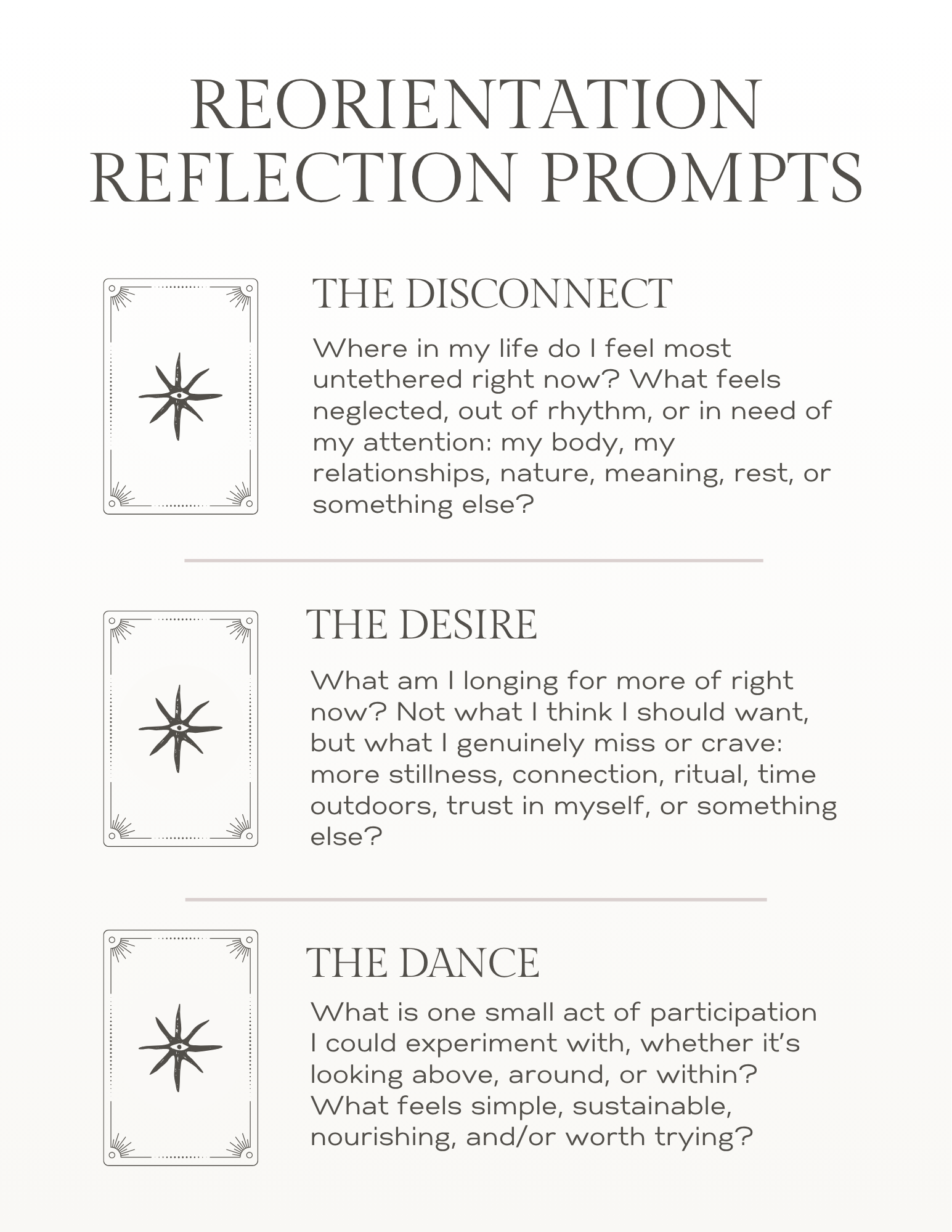
The following prompts are designed to help you identify where you feel disconnected, what you're longing for, and one small way you might begin to participate more fully in your own life. They can be used for journaling, contemplation, or as a simple three-card tarot or oracle spread.
A Return to Ourselves
Reorienting ourselves to the stars, the seasons, and our minds and bodies can help us remember that we are not separate from nature, from one another, or from the cycles that shape all life.
It points us toward a truth our ancestors understood well: we do not exist in isolation. We are shaped by our relationships, our communities, our environments, and the larger living systems of which we are a part.
The goal is not to return to or romanticize the past, but to rediscover what it has to teach us. Our ancestors faced hardships and uncertainties that many of us, thankfully, will never know. Few of us would trade modern comforts for the realities they faced, but it is worth considering what may have been lost along the way. They understood something that remains just as true today as it was then: human beings need rhythm, meaning, reflection, and connection.
We need reminding that life moves in cycles. That change is inevitable. That grief and renewal belong to one another. That rest is not failure. That uncertainty is not always something to conquer. And that we are participants in life, not merely observers of it. It is time to remember who and where we are.
In many ways, this wisdom is our birthright.
We do not need to adopt every practice or subscribe to a particular worldview. The invitation is to explore, experiment, and discover what helps us feel less untethered and more connected. Meaningful change often begins not through dramatic reinventions, but through small acts of participation: noticing the moon, taking a walk without our phone, pausing to self-reflect, taking a deep intentional breath, stepping onto a yoga mat, or simply paying closer attention to the season we are in.
After all, the stars keep moving, the seasons keep turning, and life keeps changing. The question is: are we participating in the dance?

This post is offered for educational and reflective purposes only, and is not intended as medical or mental health care. Please see the full Disclaimer for details.